
The Fabric of our Society
The Fabric of Our Society column invites industry leaders to provide experience-based opinions and discussions on various topics. Diverse perspectives are respected and most welcome, but do not necessarily reflect the opinions of IESNYC or the Board of Managers. Want to contribute? Email [email protected]
April 2026
Community as Catalyst: Why Lighting Designers Choose Entrepreneurship


Kelly Roberts, Principal, Primary Arc Design and Francesca Bastianini, Founding Principal, Sighte Studio
A clear shift is underway: a wave of new entrepreneurship in lighting design. After more than a decade of consolidation – through mergers, acquisitions, and centralization – the trend has begun to move in the opposite direction. We see more designers starting their own practices as part of a broader shift in how careers, leadership, and longevity in our profession are being imagined.
This rise in entrepreneurial spirit reflects more than personal ambition and market opportunity. It signals a deeper realignment of values, leadership, and community, and reveals how designers are responding when existing firm structures no longer support sustainable careers.
More women than ever are taking this step into lighting design entrepreneurship, and that reality is rooted in both history and community. Until 1988, women in the United States could not obtain business loans without a male co-signer. As a result, many of the women-owned lighting design firms we know today were founded after that barrier fell. We owe a great deal to those early female entrepreneurs who built their firms in a landscape with very few examples to follow. Communities like Women in Lighting + Design (WILD), founded in the 1990s, helped create networks for mentorship and visibility, supporting this entrepreneurial rise.
Today’s entrepreneurs face a whole new set of challenges: rapidly evolving technologies, expanding scopes that include controls and sustainability, shifting business models, and increasing pressure to adapt quickly. At the same time, we enjoy the freedom to imagine new futures for what a lighting design practice can be, whom it serves, and how it operates (a privilege earlier generations rarely had). This tension between complexity and possibility lies at the heart of why this conversation matters now.
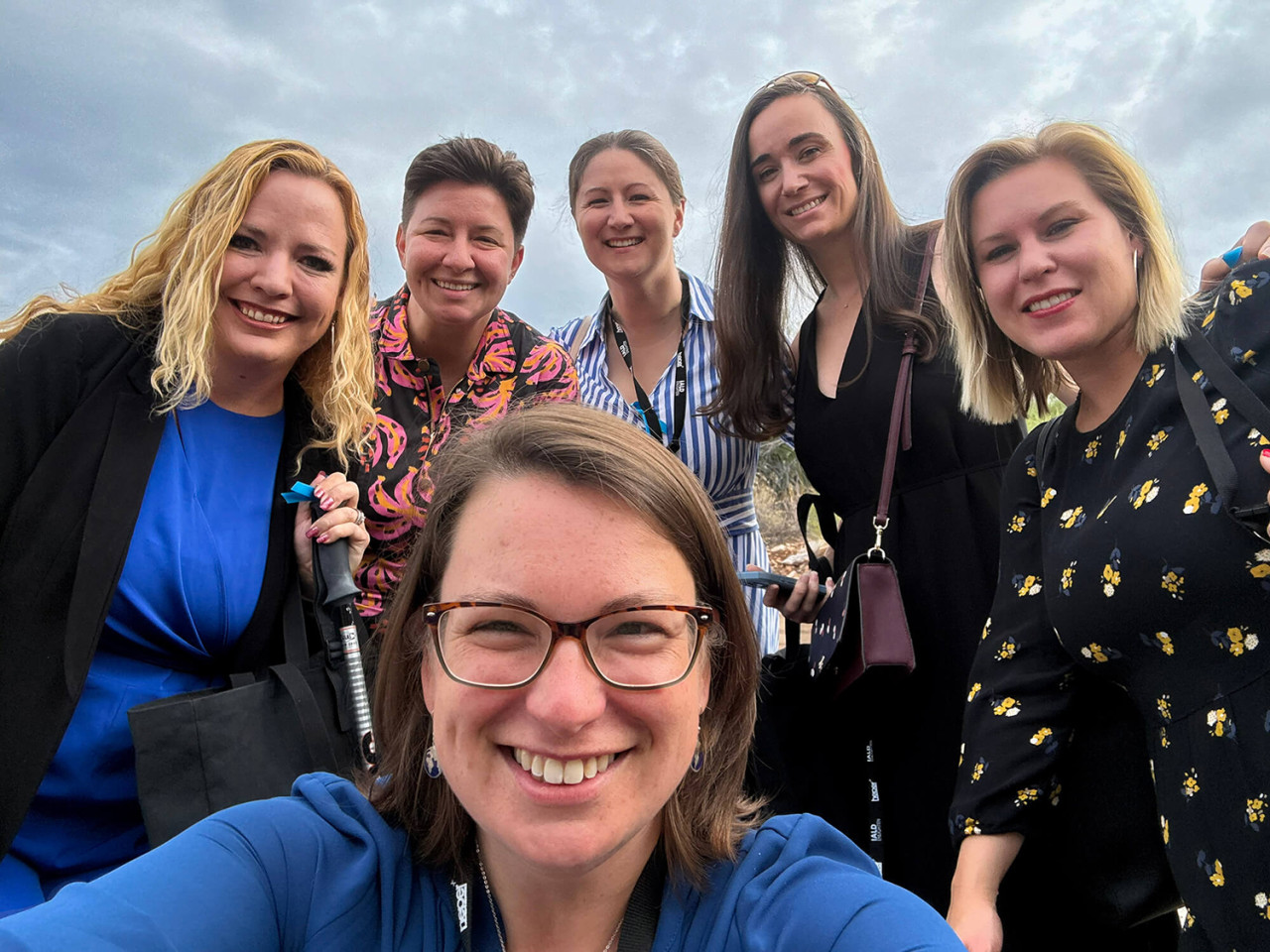
From left to right: Diane Borys, Francesca Bastianini, Kelly Roberts, Jennifer Sanborn Loukas, and Addie Smith.
Group selfie by Sara Schonour at front.
Glowing and Growing together
Against this backdrop, our panel, Glowing and Growing, came together at IALD Enlighten Americas 2025. Francesca and I joined Diane Borys (Noctiluca Lighting), Jennifer Sanborn Loukas (Lighting Playground), Addie Smith (Studio Adelia), and moderator Sara Schonour (Luxsi) to discuss the motivations that brought each of us to launch our own lighting design firms. Together, we represent firms between 1 and 9 years old, with distinctly different business models, risk tolerances, and definitions of success.
The panel brought our perspectives and previously private conversations into a public forum. Over the course of about a year, several of us met regularly as a small peer group (informally known as Boss Babes) to talk candidly about the realities of business ownership. Those discussions ranged from business logistics like contracts and cash flow, to personal concerns like burnout, boundaries, and self-doubt. They built on relationships that had been developing for years. We quickly realized that many of the challenges we were navigating individually were, in fact, shared experiences.
The panel allowed us to broaden our conversations and acknowledge questions that many other designers are quietly asking: What does a sustainable, fulfilling career in lighting design look like today, and what can we do when an individual firm’s culture no longer supports that vision?
What are designers searching for?
Many people frame entrepreneurship around an individual decision or situation, but it is also a systemic response. Most lighting designers begin hoping to work at prestigious firms on meaningful projects. After a while, some conclude that entrepreneurship is the only path to growth, flexibility, or leadership. Designers considering entrepreneurship are typically not chasing freedom for its own sake; they are seeking alignment.
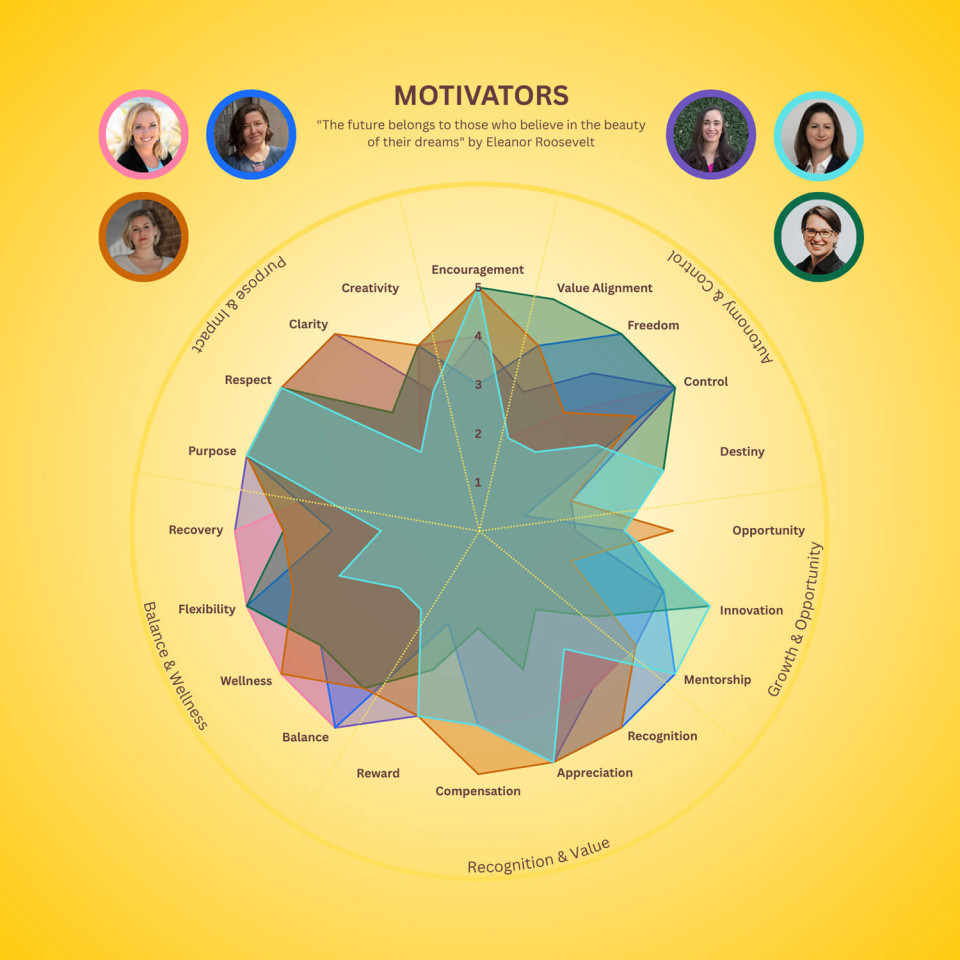
The panelists rated their motivators for entrepreneurship on a scale from 1 to 5.
Flexibility emerges as a recurring theme. Most designers yearn for the ability to shape their own schedules, select projects thoughtfully, and control creative direction. Structural autonomy also factors significantly. Many designers want the opportunity to define firm culture, articulate values, and build workplaces that reflect how they believe design work should happen. Stalled advancement also drives entrepreneurship. When a promotion is delayed or responsibility increases without corresponding authority, designers begin to question their future.
Underlying all, we desire coherence between our personal values and professional practice, between our effort and recognition, between our contributions and agency. These motivations surfaced repeatedly across our panel, even among business owners who chose very different paths.
Opportunities for retention
To current firm owners, this moment presents both a challenge and an opportunity.
A healthy firm culture begins with psychological safety. Are questions welcome? Is feedback constructive? Do designers feel seen beyond their most recent output? When autonomy is absent, entrepreneurship can begin to feel like the only viable alternative.
Great leaders model both flexibility and trust. Structured mentorship within the firm is invaluable, particularly when paired with transparency around how the business operates. Investing in professional development (including participation in organizations such as IES, IALD, DLF, WILD, ALC, BUILD, etc.) signals that an employer values growth as much as billable hours.
Clear pathways to leadership and ownership are crucial. Even when ownership is not immediately possible, understanding how leadership is cultivated and whether ownership could be part of a future trajectory allows designers to envision a long-term role within the firm. Inviting employees to the table strengthens a firm. Why are certain decisions made? How are projects actually won? Is our firm financially healthy and how do we plan to maintain that?
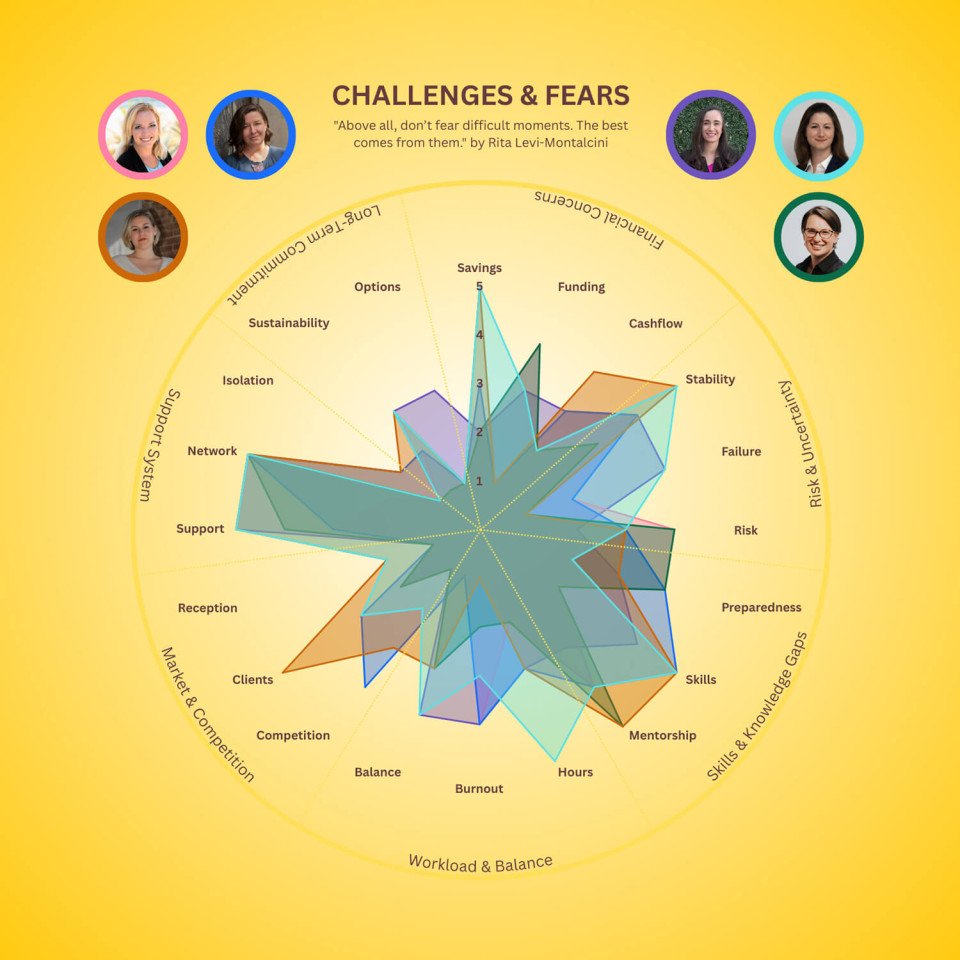
The Glowing and Growing panelists had to face their fears before taking the entrepreneurial leap. Here they rated some potential stumbling blocks on a scale from 1 to 5.
When “ready” isn’t the right word
Lighting designers who choose to start their own firms rarely have a sudden moment of clarity: it emerges gradually. Experience accumulates, confidence builds, networks expand, and external conditions shift. Taking the final leap is often the hardest part.
Some of us reached a breaking point when existing structures could no longer accommodate our growth, autonomy, or leadership. Others found themselves repeatedly asking for change that never materialized. In those moments, staying began to feel more limiting than leaving, even when the path forward was uncertain. Readiness often comes from recognizing that the relationships, skills, and resilience required to move forward are already in place.
It is also important to acknowledge that lighting design entrepreneurship is not the only outcome of these realizations. Some designers move into roles with manufacturers, agents, or adjacent sectors where their expertise is applied differently and often more sustainably. These shifts are not failures of design firms or of individuals. They are signals – about where opportunity, clarity, and support currently exist within the industry. And in many cases, designers later return to practice with a broader perspective and valuable experience.
Why this matters for the industry
Small and emerging firms play a vital role in the lighting ecosystem. They introduce diversity of thought, encourage experimentation, and often operate with agility that benefits clients and collaborators alike. Entrepreneurship also fuels advocacy, volunteerism, and knowledge-sharing. These contributions enrich the industry far beyond the practice of lighting design.
Manufacturers and reps depend on a vibrant network of design firms of all sizes. Supporting entrepreneurial designers (and helping well-established firms retain talent) strengthens collaboration, improves project outcomes, and sustains the lighting industry as a whole. When designers exit because they see no clear path forward, the loss is felt across the industry.
Community as the real catalyst
Starting a firm is not about escaping a situation: it’s about building something new. The wave of entrepreneurship we are witnessing is a way to re-examine how lighting design firm culture, leadership, and support actually function in the discipline. In this sense, entrepreneurship becomes feedback: a signal of where structures succeed, where they fall short, and where new models are needed.
No one builds alone. Strong communities can turn individual uncertainty into shared momentum. Mentorship, peer groups, and industry organizations all shape the environment in which designers either stay, grow, or leave. When those networks are substantial, designers are empowered to support one another, share knowledge, and invest in collective growth. Together, the lighting industry becomes more resilient, more innovative, and more inclusive.
Our group found one another, built a peer community, and began actively exploring how to build and support the change we sought. Our hope is that this conversation expands beyond this panel, bringing more firms into a shared dialogue about how we support designers, leadership, and long-term careers across the industry. When we invest in community and create space for growth at every level, we strengthen not just individual firms, but the future of the profession itself.
Editor’s note: This column springs from the panel discussion "Glowing and Growing: Tales of Entrepreneurship in Lighting," presented at the International Association of Lighting Designers’ 2025 Enlighten Americas conference. Coming soon, part two discusses the mechanics of starting a lighting design firm.
2026 IESNYC Event and Educational Sponsors
Brilliant Sponsor

Radiant Sponsors


Glow Sponsors
Sparkle Sponsors
Lutron Electronics | Light Abilities
Twinkle Sponsors
Available Light | Hartranft Lighting Design | HLB Lighting Design
KGM Architectural Lighting | MGE Lighting Design Collaborative | Pierce Lighting Studio
