
The Fabric of our Society
The Fabric of Our Society column invites industry leaders to provide experience-based opinions and discussions on various topics. Diverse perspectives are respected and most welcome, but do not necessarily reflect the opinions of IESNYC or the Board of Managers. Want to contribute? Email [email protected]
August 2025
Reducing Flicker: Is It Worth the Price?

Naomi Miller
Retired lighting nerd, but still fighting for quality lighting!
Today I am the discouraged temporal light modulation queen. Or let’s use the colloquial term: flicker queen. I just moved into a retirement community in Oberlin, OH, where I have my own 1200 sqft cottage. I was given some leeway in flooring, paint finishes, and countertops. And, yes, I could specify lighting for installation – as long as I was willing to pay for it.
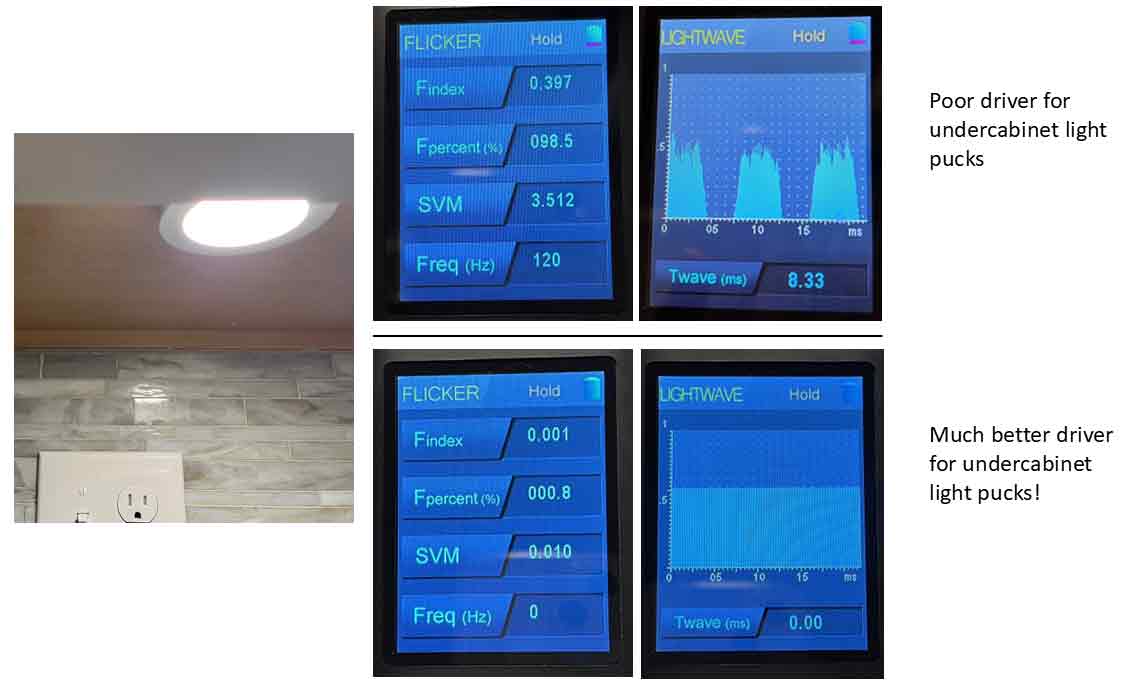
I moved in in November to find that the “flicker-free” undercabinet lights I specified, flickered (of course). Not mild flicker, but really awful: 120 Hz, on/off rectangular wave, 100% percent flicker! I made a call to the manufacturer’s engineering staff to figure out what to do, and they sent me a replacement driver. It was about 20% larger than the original, but Hooray! It fixed the problem. See my before and after measurements in Figure 1. You can see a jagged waveform with alternating on and off time and 98.5% percent flicker in the top panels (before); and a smooth output waveform with less than 1% flicker in the lower panels (after).
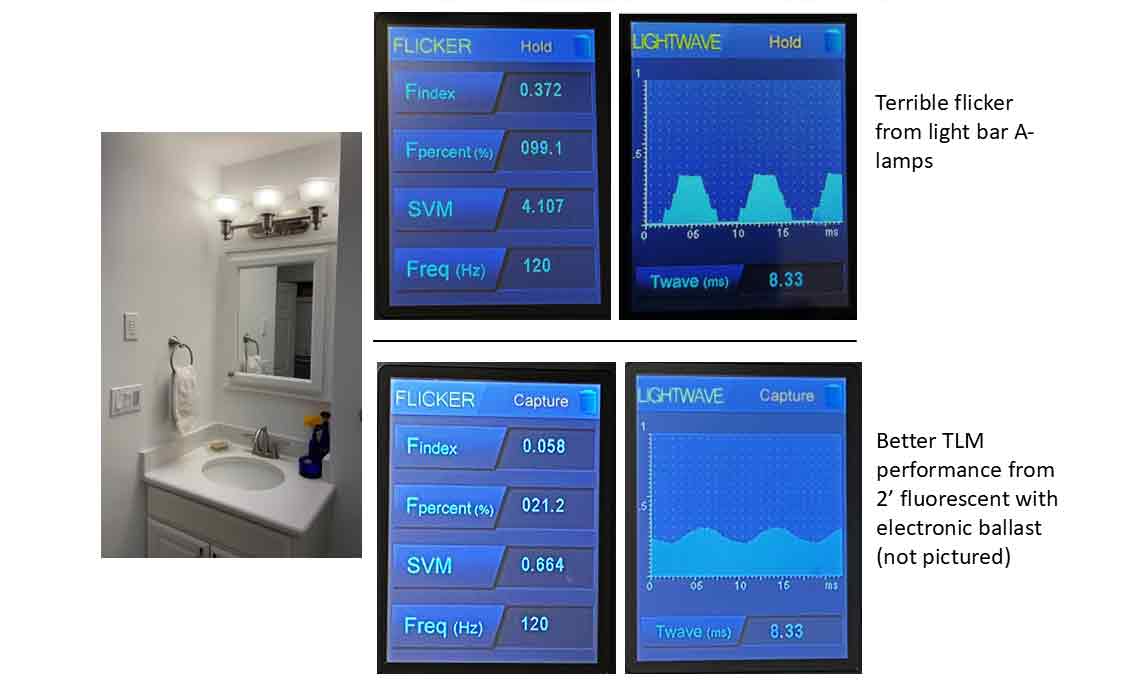
The light bars over the bathroom sinks use screwbase LED A-lamps. Now I’ve seen flicker from some A-lamps before, but nothing like this: 120 Hz, 100% modulation, and a stepped-pyramid–shape waveform that points to the lamps being low-cost technology. Every time I moved my arms in that bathroom, it looked like a funhouse strobe show. Fortunately, I had moved my favorite electronic-ballast fluorescent light fixtures from my house in Portland, so it was just a matter of weeks until those happily replaced the light bars. See before (top panels) and after (lower panels) measurements in Figure 2. A resident who didn’t have a favorite fixture ready to install would need to shop for better A-lamps, with no packaging information to help them choose reduced-flicker bulbs.
Should I even mention the 5000K dedicated LED utility lights installed by the facilities folks over the laundry and storage closet? Nah. You get the picture.
It’s not frivolous or imaginary
Fortunately, I know about this stuff and know how to fix it. I know how to replace luminaires, drivers, and dimmers. So I didn’t involve hiring an electrician at the local rate. I also know how to explain the issue to electricians and facilities people. How do they respond? They are polite. They say, uh-huh, and too often roll their eyes on the way out the door.
Dang it, we have the same problem that folks with peanut allergies have faced for decades. According to the American Academy of Allergy, Asthma & Immunology, only 1.8% of the US population lives with that condition. But when exposed to even tiny amounts of peanuts, their response can be life-threatening. I’ve been on planes where the flight attendants announce that no peanuts will be served on the flight because of one passenger’s allergy. I heard grumbling from my fellow passengers. Do they consider the allergy frivolous or imaginary?
How many people in the US respond negatively to LED flicker? We don’t have a clear answer, but we know people who experience migraines (15.3% of the population) are more likely to see flicker and suffer headaches from the phantom array effect, which is one type of temporal light modulation (TLM; aka, flicker). Then, there are other groups of people who may experience nausea or disorientation from TLM, whether they see it or not; and folks who respond with seizures in extreme cases. And there are growing anecdotal reports of TLM producing higher rates of autistic behaviors. Scientists are testing whether neurodiverse children may be more subject to negative responses. A conservative estimate is that 15% of the population may be at risk of unhealthy responses to flicker; and a small subset has such extreme eye pain, headaches, and brain fog that they may become hermits in their own homes.
Studies have shown that perhaps up to 10% of the population cannot detect the phantom array effect at all, even waveforms that seem obvious and distracting to most people. Another large percentage may see it, but they have no adverse reaction: no distraction, no eyestrain, no headaches, no fatigue. You can understand why they might roll their eyes at some fussy lady’s complaint about the lighting in her cottage.
We can solve it
So, we have an uphill battle in front of us. Flicker is a very serious health issue, but only for a small number of people, but 15–20% of the population is hardly inconsequential.
This issue needs continued and more attention. Some groups see LEDs as a successful technology transition because most of the problems of color, optical control, and dimming have been solved (if you understand how to select lighting using esoteric catalog numbers). So, their attention moves elsewhere. But flicker is not solved yet, and it seems to appear in an increasing number of lighting products.
We can solve flicker, too, by insisting on
- Better dimmer-driver performance (combinations of higher frequency, lower modulation, smoother waveforms, etc.)
- Publication of flicker metrics for products (see IES Technical Memorandum 39 – Quantification and Specification of Visual Responses to Temporal Light Modulation).
Manufacturers and specifiers need to understand that better LED driver and dimmer products may need additional electronics to increase frequency and reduce electromagnetic interference. These drivers may be physically larger, and may cost a little more. But it’s a small price to pay for improved public health. And it may be a way to differentiate product quality in the marketplace.
2026 IESNYC Event and Educational Sponsors
Brilliant Sponsor

Radiant Sponsors


Glow Sponsors
Sparkle Sponsors
Lutron Electronics | Light Abilities
Twinkle Sponsors
Available Light | Hartranft Lighting Design | HLB Lighting Design
KGM Architectural Lighting | MGE Lighting Design Collaborative | Pierce Lighting Studio
