
The Fabric of our Society
The Fabric of Our Society column invites industry leaders to provide experience-based opinions and discussions on various topics. Diverse perspectives are respected and most welcome, but do not necessarily reflect the opinions of IESNYC or the Board of Managers. Want to contribute? Email [email protected]
November 2026
Preparing Emerging Lighting Professionals in the Era of AI
 Peter Ngai
Lighting Innovation Mentor and Consultant
We are entering a very different period in the lighting profession.
During my career, I have seen many major changes—from fluorescent lamps to LEDs, from relatively simple lighting controls to connected systems, and from hand calculations to sophisticated computer modeling. Each new technology changed the way we worked.
Now we are entering the era of artificial intelligence, and I believe AI will change our profession profoundly. AI can find information, perform analysis, generate ideas and help solve problems in seconds. What once took hours or days can now sometimes be accomplished in minutes.
But this raises an important question for emerging lighting professionals:
If AI can provide so much knowledge and do so much of the work, what should a young professional learn to do?
My answer is that the fundamentals of becoming a good professional have not changed. In fact, they may be more important than ever.
Learn Continuously
Knowledge is ever expanding and has no end.
AI can put an enormous amount of information at your fingertips. But having access to knowledge is not the same as understanding it.
You still need to learn the fundamentals of lighting: light and vision, optics, photometry, color, controls, energy, codes, architecture, human needs and design. Without that foundation, how will you know whether the information AI gives you is correct?
Use AI to learn faster. Ask questions. Explore subjects outside your normal expertise. Challenge your understanding. But never stop educating yourself simply because answers are easier to obtain.
The more powerful our tools become, the more important it is to understand what they are doing.
Keep Looking
If you look hard enough, there is always something new to discover.
AI is very good at finding existing information and identifying patterns. But innovation often begins with curiosity.
Don't be satisfied with the first answer. Ask: Why is it done this way? Is there a better way? What are we overlooking?
Decades ago, indirect lighting was sometimes considered dull, producing what people called a cloudy-day effect. We kept looking at the problem and eventually recognized that adding brightness to the indirect luminaire itself could change the perception of the space and make the room appear brighter. That idea eventually became a mainstream approach in offices, classrooms and other applications where visual comfort and visual performance are important.
AI can help you look. But you still have to decide where to look and what is worth looking for.
That is where discovery begins.
Seek Mentors
Learn from people who have already traveled the road.
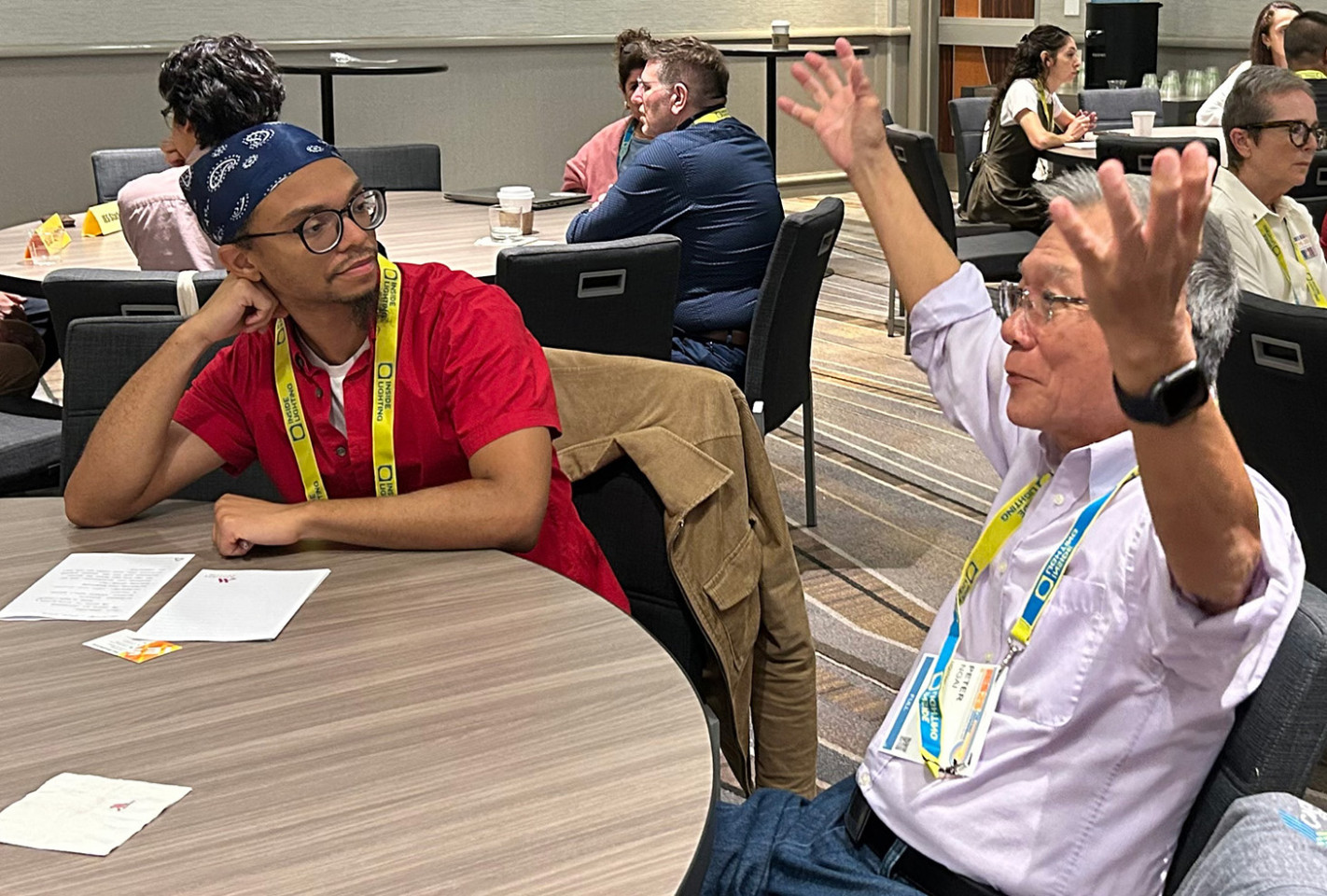 Peter Ngai and Quincy Drane at the IES Conference on Emerging Professionals Day
In 1972, my professor at CU Boulder, Dr. Ronald Helms, told me, “If you really want to learn lighting, talk to Dave.” He meant David DiLaura, who was in Ann Arbor. I was in Boulder.
No matter. I went.
For three days, David immersed me in lighting—photometry, radiant flux transfer, luminance, visual performance, numerical analysis and much more. Frankly, I was hosed.
But what a wonderful experience it was. To paraphrase a Chinese saying, “One session with Dave beats ten years of learning.”
Right then and there, I knew lighting was where I belonged. I never looked back.
A good mentor does more than give you information. A mentor teaches you how to think. AI may help you find the fish, but you still need someone to teach you how to fish.
Seek people whose experience and judgment you respect. And when you have gained experience, help the next generation do the same.
Work With People Who Believe in You
Knowledge and mentorship are important. But someone also has to believe in you enough to give you an opportunity.
For me, that person was Doug Herst.
I joined Peerless, where Doug and I began a lifelong partnership in lighting. He trusted me, encouraged me and challenged me to do things that sometimes seemed impossible.
I still remember my interview with Doug. He asked me what my vision was for Peerless. I told him:
“I want to put a Porsche engine into a beautiful body. My goal is not to make Peerless the biggest lighting company, but the very best.”
Doug believed in that vision and gave me the opportunity to pursue it.
The rest is history.
Early in your career, someone has to trust you before you have a long record of accomplishments. When someone believes in you, earn that confidence. And later, when you are in a position to help others, give another emerging professional the same opportunity.
Exercise Professional Judgment
Use AI, but remember: responsibility stays with the professional.
AI can give you an answer very quickly—and it can give you a convincing wrong answer just as quickly.
A lighting calculation can meet all the numerical requirements and still result in a poor environment. An AI-generated recommendation can sound technically sophisticated while overlooking glare, visual comfort, constructability, maintenance, aesthetics or the needs of the people who occupy the space.
So always ask:
Does this make sense?
Use AI to calculate, research and explore alternatives. But do not outsource your judgment.
AI is not the lighting professional. You are.
Take Risks—and Commit
Think outside the box.
AI works largely from what already exists. Innovation requires us to go beyond what has already been done.
Taking risks does not mean being careless. Understand the problem. Do your homework. Explore alternatives. Then use your own judgment.
And when something is worth doing, commit yourself to it 100%.
When the lighting world was largely using T12 and T8 fluorescent lamps, we believed the newer T5 lamp offered significant advantages. Manufacturers were hesitant to produce it because the demand was not there. We believed it was the right direction, so we committed ourselves to purchasing all of the manufacturer's production to help move the technology forward. T5 eventually became a mainstream light source widely used by luminaire manufacturers and specifiers.
Sometimes you have to be willing to go first.
AI can help us analyze possibilities. But the willingness to pursue an idea—and the commitment to make it happen—still has to come from us.
Stay Humble
Humility inspires generosity in others.
No matter how much we know, there is always more to learn. As knowledge becomes increasingly accessible, simply knowing something becomes less important than knowing how to use that knowledge wisely.
Listen to experienced professionals, but also listen to young professionals who may see things differently. When people see that you genuinely want to learn, they are much more willing to share their knowledge with you.
Being humble does not mean lacking confidence. You can believe strongly in an idea while remaining willing to question it.
A Final Thought
AI will change lighting practice. We should welcome it, learn it and use it.
But we should also understand what it does not replace.
It does not replace curiosity. It does not replace experience or mentorship. It does not replace courage, commitment or humility. Most importantly, it does not replace professional judgment.
2026 IESNYC Event and Educational Sponsors
Brilliant Sponsor

Radiant Sponsors


Glow Sponsors
Sparkle Sponsors
Lutron Electronics | Light Abilities
Twinkle Sponsors
Available Light | Hartranft Lighting Design | HLB Lighting Design
KGM Architectural Lighting | MGE Lighting Design Collaborative | Pierce Lighting Studio
