
The Fabric of our Society
The Fabric of Our Society column invites industry leaders to provide experience-based opinions and discussions on various topics. Diverse perspectives are respected and most welcome, but do not necessarily reflect the opinions of IESNYC or the Board of Managers. Want to contribute? Email [email protected]
September 2026
The Social Art of Lighting
 Omar Gómez González
Compositor de Iluminación Social Integrativa
When we talk about lighting, we usually do so through the language of physics, engineering, and design. These aspects are essential: illumination levels, energy efficiency, visual comfort, and sustainability. But after many years of working with light, I have come to believe that some of its most important contributions are beyond what we typically measure.
In practice, light is profoundly intuitive. We all carry memories associated with it: a window, a shadow, a street, a campfire, a sunrise. Those memories are internalized and never culturally neutral. It is far more difficult to understand how light influences trust, belonging, or the ways people relate to one another. And yet, these are often the very factors that ultimately define the true value of a place.
My interest in this social dimension of light began long before I became a lighting professional. As a child, I was fascinated by lamps and electronic devices. I collected them and took them apart, trying to understand how they worked. It was profoundly mysterious: an invisible form of energy transforms into light and completely alters our perception of the world.
One of my earliest experiments was a rudimentary lighting system that reacted to music. After many attempts and more than a few burnt-out bulbs, I managed to make the lights respond to bass frequencies. A few days later, I invited my elementary school friends into my room. We turned off the lights and played some music.
When the lights began to pulse, something happened that I have never forgotten: we all started dancing, jumping, laughing, and sharing a collective emotion that is difficult to describe. No one organized the experience. No one explained what we were supposed to do. It simply happened.
For years, I believed that memory was about technology. Now I understand that the lights themselves were not important. What mattered was what happened among us. We were all witnessing the same phenomenon and sharing the same sense of wonder. That small bedroom became my first “luminous campfire.”
The campfire
That image stuck with me because I recognized something that seems to repeat itself throughout human history. Long before electricity, people already gathered around sources of light. First the sun and moon, and later firelight, gas, and electric light. The technologies changed, but the human experience remained remarkably consistent. Light is a social technology as much as a visual one. Beyond illuminating landscapes and predators, buildings and streets, light fulfills a profoundly human function: it brings people together.
Years later, I observed this from another perspective. I participated in an international group exhibition with an interactive light installation in the shape of a pyramid, built from white market crates found on-site. I designed and programmed the lamps, sensors, and a control system myself. The piece responded to people's presence and altered its behavior as collective interaction increased. The strangers who gathered around it began collaborating spontaneously. They shared ideas and invented games around the light and its activation. The installation was not intended to create community, but it accomplished exactly that.
That brief instant of collaboration and community continues to guide much of my work. Some of the most profound transformations generated by light occur in the people who share it.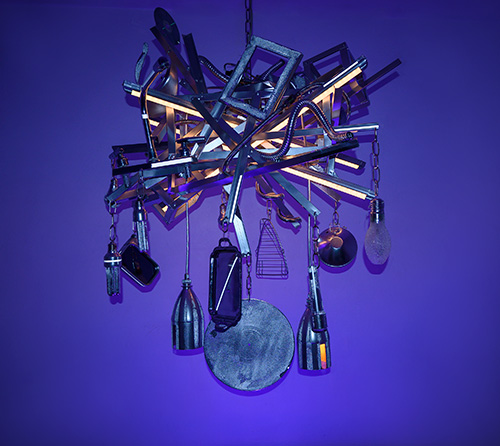
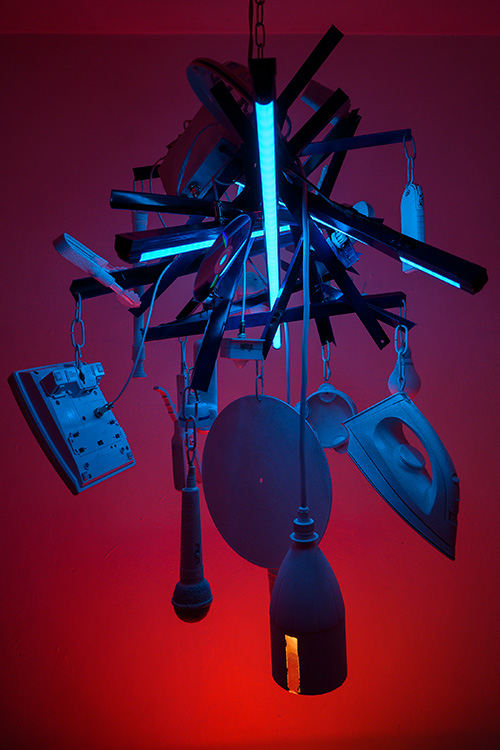
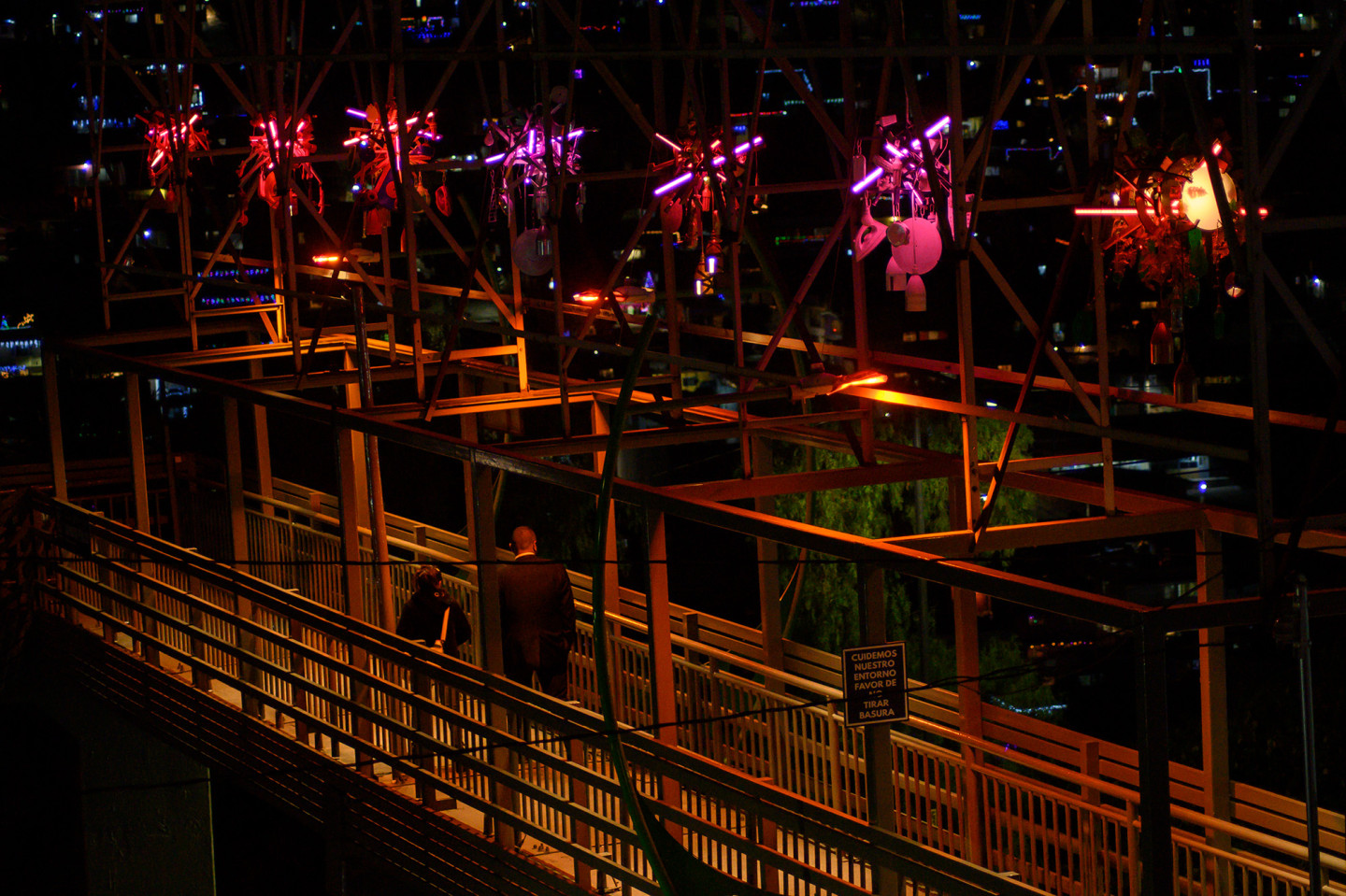
Public Luminaire, by Omar Gómez González, was intended to create community through shared memory and personal expression.
Sound and silence
Over time, I also came to understand that we cannot fully understand light without darkness. We often associate darkness with absence, risk, or deficiency. Yet many of the deepest human experiences occur within darkness. Darkness brings rest, contemplation, intimacy, and mystery. It is the space where questions are born, where ideas exist before taking form.
I came to realize that the task of lighting is to create a meaningful relationship between light and darkness. In a way, light needs darkness in the same way that music needs silence.
This ultimately transformed the way I understand my profession. Our work comprises the conditions that make human experiences possible and often harmonious.
Orchestrating spaces
From this perspective emerged the figure of the “Integrative Social Lighting Composer.” This is not so much a professional title as an approach to the practice of lighting. Just as a composer organizes rhythms, harmonies, and silences to generate meaning, those who work with light articulate physical, emotional, social, and cultural dimensions within a shared experience.
This requires abilities and approaches that rarely appear in technical manuals: listening before intervening, observing before proposing, walking through spaces at night, learning local stories, recognizing symbols, understanding everyday rituals, identifying social wounds, and understanding how a community constructs meaning around a place. We work to help people rediscover their own personal and cultural relationship with light. We can learn from the ways people perceive it, experience it, and create meaning through it.
My project Public Luminaire gave this vision its clearest expression. What began as an interactive artistic lighting project eventually became a process of collective creation. Residents shared stories, contributed personal objects, and actively participated in the construction of the luminaires. Infrastructure ceased to be merely infrastructure; it became shared memory and the local community’s expression.
Neither the light produced by the luminaires nor their aesthetic form proved most important. It was the sense of belonging that resonated throughout the process. The community ceased to be a user and became a designer.
I see you
Light can be a form of social medicine. It doesn’t cure illnesses or solve a community’s problems on its own. Light, in form and function, can help strengthen relationships, rebuild trust, and restore meaning to places where it seemed lost. This understanding shapes my work profoundly.
Light was never here solely to help us see the world. The social art of lighting plays an important role in this era when so many things seem determined to separate us. Light possesses a unique capacity to bring us together, to make us observe collectively, and to create shared moments of presence, reflection, recognition, and hope. This is perhaps one of the deepest responsibilities of the Integrative Social Lighting Composer: to help light do this work of truly seeing one another.
2026 IESNYC Event and Educational Sponsors
Brilliant Sponsor

Radiant Sponsors


Glow Sponsors
Sparkle Sponsors
Lutron Electronics | Light Abilities
Twinkle Sponsors
Available Light | Hartranft Lighting Design | HLB Lighting Design
KGM Architectural Lighting | MGE Lighting Design Collaborative | Pierce Lighting Studio
