
The Fabric of our Society
The Fabric of Our Society column invites industry leaders to provide experience-based opinions and discussions on various topics. Diverse perspectives are respected and most welcome, but do not necessarily reflect the opinions of IESNYC or the Board of Managers. Want to contribute? Email [email protected]
July 2026
Paths to Success: How Lighting Designers Manage Entrepreneurship


Francesca Bastianini, Founding Principal, Sighte Studio and Kelly Roberts, Principal, Primary Arc Design
My father often said, “Fra il dire e fare c’è di mezzo il mare,” which translates to “between saying and doing there is a sea.” There is much to founding a new design studio, and much of that goes unnoticed. Our previous article, Community as Catalyst, explored why lighting designers strike out on their own: creative freedom, control over project typologies, and the desire to build something that reflects their values. Here we’ll share some of the less-glamourous suggestions to help lighting designers with that entrepreneurial fire in the belly.
Note that there is no single path forward. When our panel discussion, Glowing and Growing, came together at IALD Enlighten Americas 2025, we shared our consensus on what to prioritize. Kelly and I joined Diane Borys (Noctiluca Lighting), Jennifer Sanborn Loukas (Lighting Playground), Addie Smith (Studio Adelia), and moderator Sara Schonour (Luxsi) to discuss our unique values, risk tolerance, financial circumstances, and professional goals. Together, we represent firms between 1 and 9 years old with distinctly different business models. One designer’s boutique is another’s launchpad for a multi-division firm.
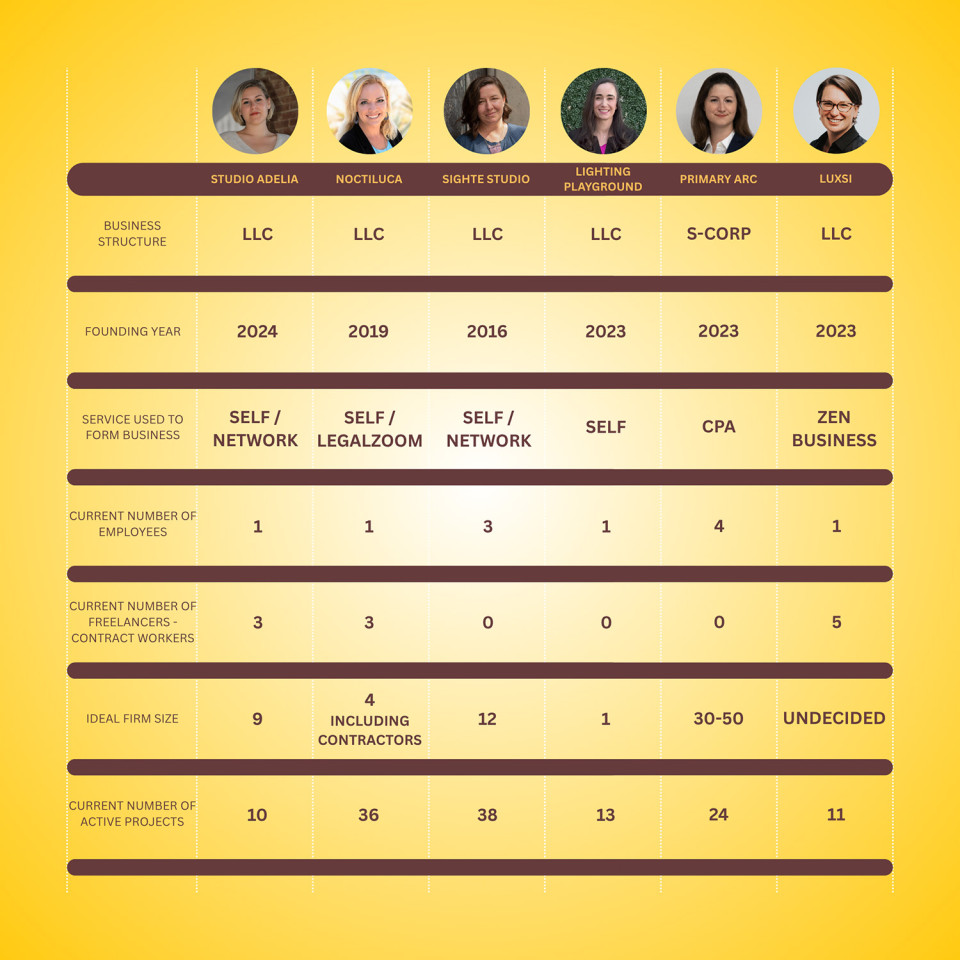
The Glowing and Growing panelists took a variety of paths to form their “ideal” business entity.
Think of this article not as a checklist or solve-all roadmap, but as a collection of frameworks, hard-won lessons, and practical strategies. It is a toolkit to draw from at any stage of your journey.
What is a successful business structure?
When we start a design firm, we need to know who we are as designers and what we want to offer. Clarifying your mission and values is a seemingly vague step, but it’s a crucial one. Your mission and vision statements will serve as your beacon for years to come.
Perhaps the most important advice we have to offer: define what success looks like and where your values lie before the work begins, because these will shape every decision that follows. Does success mean recognition and prestige? Are you in it for maximum revenue? Do you want to find more time for the growth of a family or caregiving? Do you envision building a team you are proud to lead? There’s no wrong answer, and there is space for every type of goal. But leaving these questions unanswered can result in murky priorities. Your definition of success and your values will help you stay aligned, even as circumstances and priorities change.
One vital early decision can be informed by your plans for success: the entity’s legal structure. Common options in the US include sole proprietorship, LLC, partnership, and S-Corporation. A sole proprietorship is simplest but offers no separation between personal and business liability. An LLC provides that separation while remaining flexible. A partnership formalizes how profits and responsibilities are shared between co-founders. An S-Corp can offer tax advantages for firms at a certain revenue threshold, allowing owners to take profits as distributions and reduce self-employment tax. Please, please consult an accountant or legal professional on which structure might suit your mission and financial situation.
Planning for growth
Whether you plan to be a sole practitioner or envision a large team, winging it works – as long as you have the steam to be constantly solving problems and those conflicting priorities. Especially if you are launching at a time where you have limited projects or prospects, take the time to set up processes and workflows.
The work you do to present yourself to the public should carry equal effort and importance to how you present yourself to your team. Do you have standards that can be easily followed? Can you easily delegate and maintain quality as you grow? How do you decide whether to take on a new client or project? Knowing at least the outlines of these answers before you start allows the business to feel proactive and ultimately should result in less stress.
For designers committed to the boutique model, growth can mean deepening impact and raising the ceiling on project complexity, not necessarily adding employees. The hybrid approach offers a middle path: a core team of full-timers complemented by trusted collaborators and freelancers engaged as needed.
For those looking for growth, diversify through building multiple services that can support one another during slow periods. A firm organized around distinct but related divisions (core design, purchasing, controls and technology, consulting) can cross-refer work, share overhead, and smooth revenue volatility. When one division cools, another may be heating up.

Perhaps the most important advice: define what success looks like before the work begins. Here the panelists rated their priorities on a scale from 1 to 5.
Contracts, boundaries, and lessons learned
Collectively, the Glowing and Growing panel sees the designers with the healthiest businesses are the ones with the clearest agreements. Project and freelance contracts rarely begin as polished templates. And in our industry, they can sometimes feel like wild guesses or suggestions that get ignored.
However, developing strong terms and anticipating potential changes to scope or details can help protect profits and maintain good relationships. We have learned that, for most of us, contract language is strengthened through experience. A misunderstanding about value engineering on one project may lead to a new clause. A difficult client experience results in an entirely new section on additional services. Details that most commonly generate confusion include fee structures and what’s included versus billed separately; revision expectations; construction administration compensation; and conditions under which additional fees are triggered, and (we can’t stress this enough!) payment terms.
Exploring your own relationship to money and the stories you tell yourself about it can clarify whether you will feel comfortable having these difficult conversations around late payments, added services, and compensation for the value you bring to a project.
While many designers have developed contracts through experience, we have also found it important to seek advice from lawyers who know the design and construction market and can speak to contract law. As projects become more complex, so do the terms. Don’t assume that you have to do this alone.
The contract is part of the boundaries that we create, not as an obstacle to good design but to enable it. They are what make quality work sustainable. A designer who consistently undercharges, overdelivers without compensation, and absorbs scope creep without objection will eventually face burnout or business failure. Clear agreements protect not just income, but creativity, soul-sustaining energy, and your basic desire to continue in your business.
Pipeline, marketing, and client fit
Once you have the why, the structure, and the agreements, then you need projects. Where will the work come from? The answer, almost universally, is relationships. Small firms rarely grow only through advertising or cold calls. They grow through referrals, reputation built project by project, and consistent presence at architecture and interiors events.
A CRM tool, even a well-maintained spreadsheet, can help ensure that relationships don’t fade through neglect. Social media, used thoughtfully and authentically, can extend your reach beyond an immediate network. Research collaborations and academic partnerships offer another avenue for designers seeking thought leadership alongside their practice work.
Equally important as finding clients is vetting them. We often speak about why we want a project and have an internal go/no-go checklist. Useful signals include the quality-level of the broader project team, the decisiveness of decision-makers, payment history, and the portfolio value of the project itself. A well-executed project with a reasonable client is worth more, in the long run, than a lucrative but draining engagement. We seek collaborators that we can work with for years to come. This is often about finding clients with common values and communication styles.
Our panel of entrepreneurs also suffers from an abundance of volunteerism and committee participation in professional organizations. However, we have found that these are key places for growing relationships and resources that are consistently underrated as business development strategies. They build trust in ways that formal networking rarely replicates. Just remember to check in with yourself regularly to make sure you are doing work that is filling your cup, not just keeping you busy.
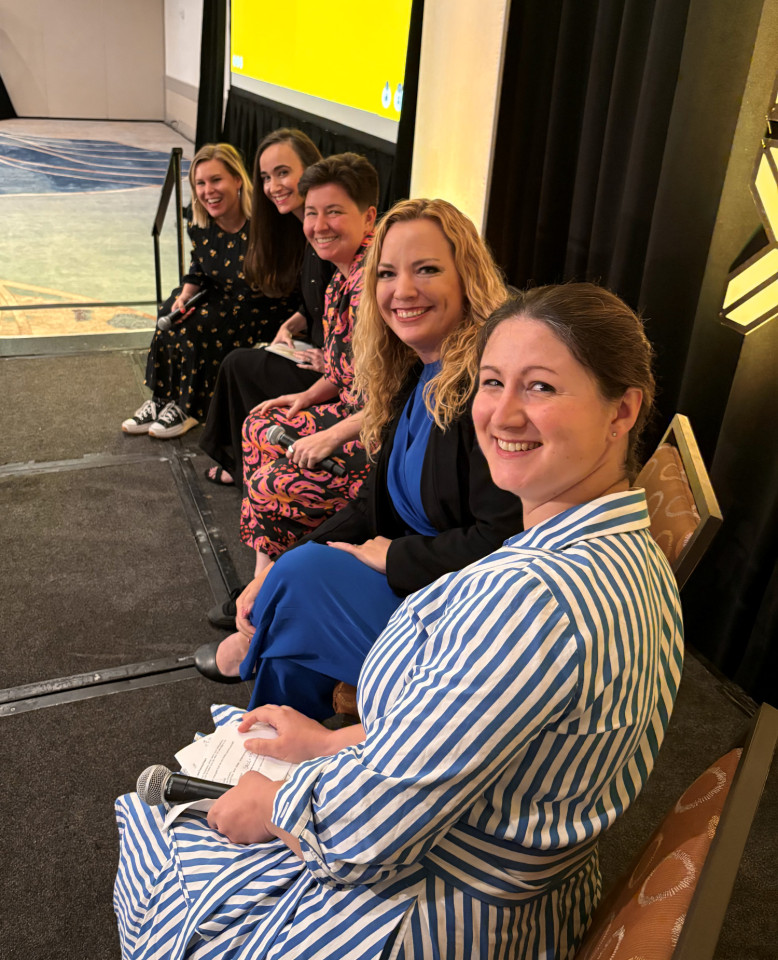
From fore to rear: Glowing & Growing panelists Kelly Roberts, Diane Borys, Francesca Bastianini, Jennifer Sanborn Loukas, and Addie Smith. Photo by Sara Schonour (not pictured).
Considering the leap yourself?
The guidance that emerges most consistently from designers who have launched their own studios comes down to a few principles.
- Understand your financial model and risk tolerance before you begin: know your break-even point and what your fallback looks like if year one is slower than expected.
- Build your community before you need it, which includes mentors, peers, and collaborators. These are best cultivated before there’s an immediate ask.
- Begin with boundaries, not after burnout. It is far easier to establish clear expectations from the first client conversation than to retroactively install them later.
- Expect to iterate. Your business plan is a living document that should be revisited at least annually.
- If you’re uncertain whether independence is right for you, commit to a defined experiment: give yourself a year, set clear criteria for success, and evaluate honestly.
Most importantly, keep your values at the center of every decision. Those of us who share satisfaction in taking the leap are not always those with the highest revenue or biggest team or most high-profile projects. Surveying our entrepreneurial colleagues, we find success comes when mission and vision are aligned with daily work.
Shared success
While this guidance is by no means exhaustive, the point is to share from our experience. Having been through the process, we want others to succeed as well. In our often-small, convivial industry, we have the benefit of celebrating others without missing out on our own success.
It’s not pie. There are always more projects that can benefit from a lighting design consultant. And when new firms are built thoughtfully, with clear values, sound structure, and genuine relationships, the benefits extend far beyond the individual designer. More independent firms mean more innovation, more collaboration, more diversity of thought, and stronger partnerships across the industry.
To designers at the precipice of taking the leap: seek community before you need it. Over the course of about a year, several of us met regularly as a small peer group to talk candidly about the realities of business ownership. Those discussions ranged broadly and built on relationships that had been developing for years. Many of the challenges we were navigating individually were, in fact, shared experiences. The 2025 Enlighten Americas panel brought our private perspectives and conversations into a public forum.
We ask you to share what you know openly and create generous spaces for others to rise alongside you. In the lighting industry, that sharing of expertise and glow of fellowship are most often the point.
2026 IESNYC Event and Educational Sponsors
Brilliant Sponsor

Radiant Sponsors


Glow Sponsors
Sparkle Sponsors
Lutron Electronics | Light Abilities
Twinkle Sponsors
Available Light | Hartranft Lighting Design | HLB Lighting Design
KGM Architectural Lighting | MGE Lighting Design Collaborative | Pierce Lighting Studio
