
Meet Our Member
The IESNYC spotlights a member each month whose volunteerism, perspective or personal story helps advance our goals, piques our curiosity, and makes the IESNYC become a more vibrant and diverse lighting community. We value their expertise and thank them for volunteering their time and energy for the betterment of the section and NYC Lighting Community. #the_iesnycmom
August 2025
 Jim Toole
Vice President of Sales, NYC
Selux Corporation
Q: How did you first get started in the lighting industry?
I was a sophomore in college, studying industrial design at the University of Bridgeport in Connecticut. One evening I was walking through South Norwalk, where an aquarium had just been built and they were revitalizing the streets nearby with retail, restaurants, and converting the loft-like buildings into offices and a few apartments. One store stopped me dead in my tracks. It was glowing. Primo was a lighting store that had exciting European eighties-design light fixtures. I was infatuated and spent about a half an hour looking through the window while the store was closed.
The next week, a friend mentioned that they were looking for someone to help in the showroom. I was nervous, and stunned by the quality of the products. But the people most impressed me, including Megan Carroll who interviewed me and became my boss. (And later, my spouse of 18 years.)
I began working weekends selling, as well as doing small tasks like installing fixtures and moving displays. One of the products they sold were Lutron dimmers, which proved most interesting. I say that because one day I was up on a ladder about 12 ft in the air changing a fixture fitting on a Saturday morning. (You can imagine my state as a college kid on an average Saturday morning.) When I touched the wires to connect them, I got a bit of a shock. That was a rude awakening. So I asked my boss to reach over to that Lutron dimmer and push the slider all the way to the very bottom. That was my introduction to controls: shocking!
It turns out that store was owned by John Tremaine, who now owns QTL, formerly Q-Tran. John had a lighting design business also associated with Primo, called Tremaine Lighting Design.
Gradually, John gave me opportunities to do lighting design, beginning with drafting floorplans and circuiting for commercial and large-scale residences. The weekend work became full-time, and then very long hours. I never looked back
Megan left Primo to work for a firm in New York City, and we lost touch. Then on July 3, 1985 we crossed paths again in a store. She mentioned that her new employer needed someone with my product and people skills, and an interest in lighting. I don’t think she expected me to respond, but the next Monday I called and got an interview.
We began commuting to New York together while working for a company importing Italian light fixtures. Megan was in sales in New York City, and I was doing technical sales and converting the products for use in the US market (UL listings and instruction sheets and generally answering agent and client questions).
Gradually, Megan and I fell in love over all those commutes. Our boss was kind of shocked when we asked for a reference to get an apartment on Roosevelt Island: she didn’t even know we were dating. We remain very much in love with each other, and with lighting.
Q: How did you first get involved in the IESNYC?
One of the first IESNYC meetings I remember attending was a tour of Edison Price‘s manufacturing facility on the East Side in Midtown. Rick Shaver gave the tour, and I was captivated. I had studied design, but I have a deep love for manufacturing and performance light fixtures. Bill Blitzer of Lightolier was at that event, and we became best friends.
Q: How do you see your role as a member of the IESNYC?
Throughout my career, I’ve been the connector between the technicalities of lighting design and products for cutting-edge designers and their projects. Years ago, I started my own custom lighting manufacturing business. Professional events and tradeshows connected me to specifiers, product designers, and marketing pros. The IES has been the foundation and reference point throughout my career, but the IESNYC has provided the best opportunities to connect and learn from people in the industry.
I got involved with the Illumination Awards and ultimately served as Chair for about 8 yrs. (At that time, the Lumen Awards were still the IESNYC Section awards, part of the national IA program.) I did this joyfully, as I find awards programs to be both a tremendous celebration and the best method to explain great lighting to people outside our community. When I joined the IA Committee, submissions were cumbersome because you had to submit a paper application and 35mm slides. We worked hard to embrace digital photography, while stressing the importance of not editing photos to enhance the lighting.
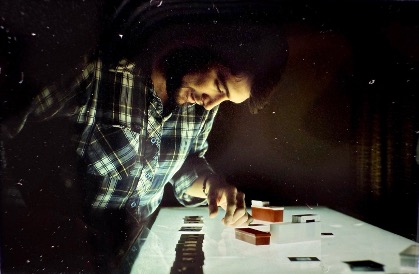
Yes, this is a 35mm slide of Jim reviewing 35mm slides back in the day
Q: In your opinion, what are the best assets of the IESNYC?
Megan and I have now been in lighting for 40 years, so you can imagine we’ve discussed this many times. For us, the IESNYC Section remains the epicenter of our lighting world. With extraordinary people doing cutting edge design, it is absolutely thrilling to contribute to this exciting community. Today, it’s most rewarding to connect with emerging professionals as they navigate their path into and through the architectural lighting design community, and the IESNYC.
2026 IESNYC Event and Educational Sponsors
Brilliant Sponsor

Radiant Sponsors


Glow Sponsors
Sparkle Sponsors
Lutron Electronics | Light Abilities
Twinkle Sponsors
Available Light | Hartranft Lighting Design | HLB Lighting Design
KGM Architectural Lighting | MGE Lighting Design Collaborative | Pierce Lighting Studio
